Greenbush and its one-room school
The first stop is fifteen minutes up US-23: a white frame schoolhouse from 1870, closed in 1947 and now the township's museum, in a village that once held far more people than it does today.
- ALLOW
- About 20 to 40 minutes
- FROM OSCODA
- About 15 minutes north
- PARK OR STAND
- Beside the township hall on Campbell Street
- NEXT LEG
- About 10 miles north on US-23 to Harrisville State Park
- BEST MONTHS
- June to September
- BRING
- Camera, a little patience for open days
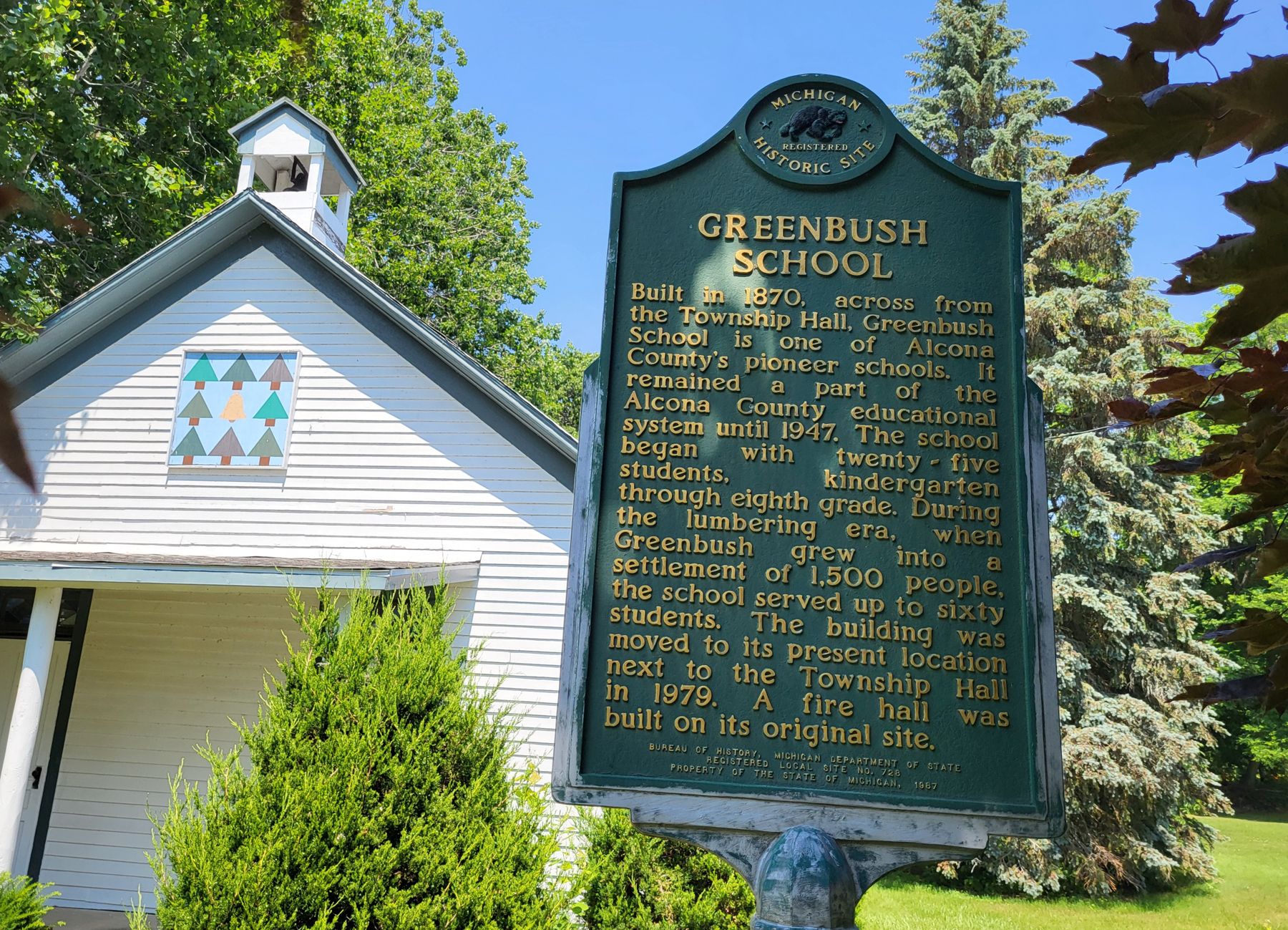
Greenbush is easy to miss at highway speed. US-23 passes a handful of houses, a township hall and the lake, and then the trees close in again. Slow down anyway. The small white building on Campbell Street, with its bell cupola and a painted quilt block on the gable, is one of the oldest schoolhouses in Alcona County, and it tells you a good deal about how this shore was settled.
From fish barrels to sawlogs
The village began on the beach. In 1848 a man from Detroit set up a fishery here, with a cooperage to make the barrels the salted catch was shipped in. Lumber followed. As the pine was cut inland, Greenbush became a landing where timber went out by water, and the settlement grew to around 1,500 people during the lumbering years. When the pine ran out, most of them left. The village you see now is a fraction of that size.
The school dates from that busier time. It was built in 1870, across the road from the township hall, and it stayed part of the county's school system until 1947. It opened with twenty-five pupils, from kindergarten through the eighth grade, and at its peak it held about sixty. In 1979 the building was moved to its present spot next to the township hall, and a fire hall went up on its original site. It is a registered Michigan State Historic Site, and the Greenbush Historical Society keeps it as a museum.
Looking around the schoolhouse
The green state marker in front of the building gives its history in a few lines, and it is worth reading before anything else. The school itself is a simple gable-front frame building, the kind that once stood every few miles across rural Michigan. Look up at the cupola, which held the bell that called pupils in, and at the quilt block on the front, part of the barn-quilt tradition that brightens many buildings in this part of the state.
Inside, when it is open, the society shows the school and items from the township's past. Open days are limited and mostly in summer, and they change, so check locally before you plan around them. The outside, the marker and the setting can be seen at any time.
05ALSO WORTH THE DETOUR · Tawas Bay and Tawas Point · stop 5The Iosco County Historical Museum and the Hawks houseHow long, and where to leave the car
Twenty minutes covers the outside and the marker; give it forty if the museum is open. There is room to park beside the township hall on Campbell Street, a short turn off US-23. In summer the trees around the building give shade, and in winter the school stands out white against the snow, though nothing is open then.
Greenbush is the first of the five stops in the short day, and it sets the tone for the rest: small, old and close to the road. It pairs naturally with the school at the far end of the tour, the log Old Bailey School at Sturgeon Point, which shows an even plainer kind of country classroom.
On to the state park
Back on US-23, keep north along the lake for about ten miles. The road passes cottages and pine and then reaches the south edge of Harrisville, where the entrance to Harrisville State Park is on the right, on the lake side. The whole stretch takes about fifteen minutes. If you are following the full tour, the Harrisville and Sturgeon Point overview has the order of all ten stops.
Every photograph here is credited, with its licence, on who took the photos.